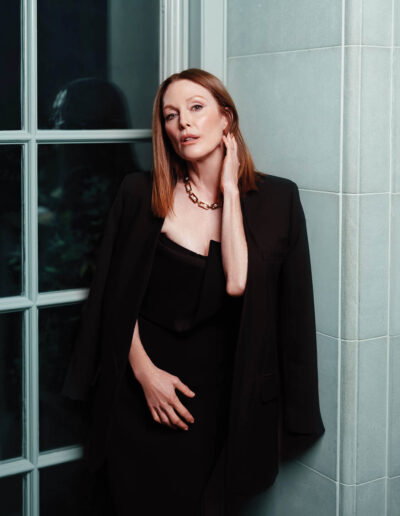
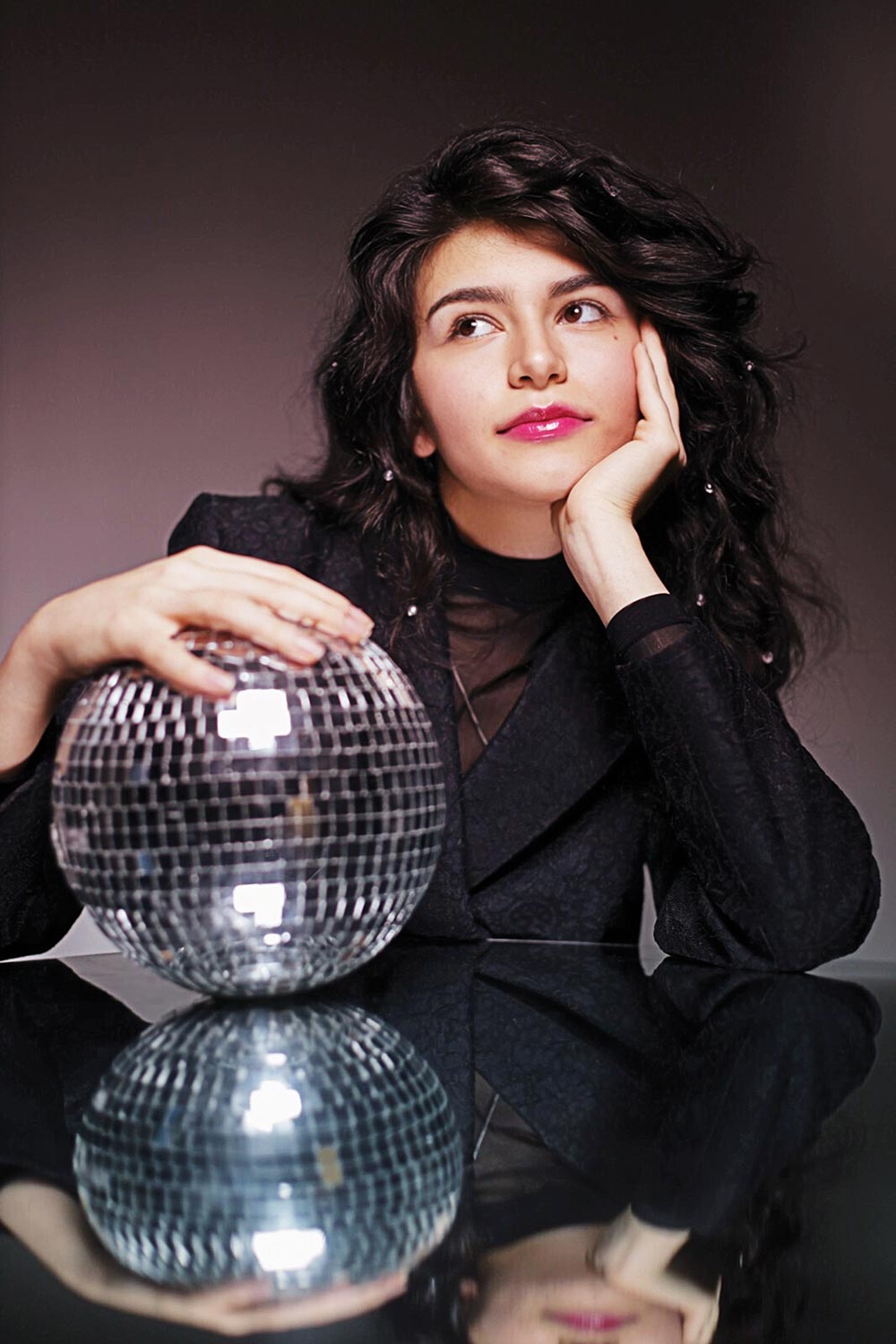

Growing up in post-Soviet Armenia – a country still rebuilding after the collapse of the Soviet Union – shaped her early curiosity about innovation. Surrounded by rapid change and an environment she recalls as almost post-apocalyptic, she developed a strong drive to create and reimagine what is possible.
As a child, she imagined building a giant resort on Neptune, reflecting her fascination with science. She later contributed to the Starmus Festival, founded by astrophysicist Garik Israelian together with Brian May. Today, she works as
Head of Finance for the Asclepios VI lunar analogue mission and represents a new generation of women shaping fields such as space exploration, technology and entrepreneurship.
Ladies Drive: Dear Tsovinar, what is your favourite memory of your childhood?
Tsovinar Avagyan: My favourite childhood memory is being at my grandparents’ home and in their garden. They had a small garden where I spent a great deal of time, especially during the summers. There were many apricot trees, and I loved gardening. My grandmother also had many flowers there, so some of the most beautiful moments of my childhood unfolded in that garden.
My grandmother was also a gifted cook, and we cooked together often. I was very close to my grandparents. She made many dishes with meatballs, which I loved – they were among my favourites.
To help us understand your childhood a little better, can you tell us where you grew up?
I grew up in Yerevan, the capital of Armenia. I was born in 2002, and at that time Armenia was only eleven years into independence. That was how long the country had been independent from the Soviet Union when I was born. Everything was still being rebuilt while I was growing up. In a way, I grew up amid constant change from a very early age. My surroundings sometimes felt almost post-apocalyptic.
It is a very unique experience, I would say, to grow and evolve alongside your environment. I believe that is special because, growing up in such circumstances, you also develop a sense of personal responsibility. That keeps you motivated to push forward.
What did you dream of becoming when you were a child – and perhaps later as a teenager?
When I was a child, I wanted to become an entrepreneur. There’s actually a very funny and charming story behind that.
As I mentioned, everything was being rebuilt, and the private sector was moving much faster than government. I grew up seeing many small, family-owned businesses. I remember the first time I stepped into a supermarket and saw an employee – I wondered whether he was the owner. Then I thought, “No, he looks like a teenage boy. He’s too young to be the owner.”
I was maybe three or four, but I was already curious about who was behind it all and how so many things – toys, food and clothes – could be brought together so conveniently.
That’s when I began to understand the power of entrepreneurship: creating value, making life easier and shaping the environment quickly. Since then, I’ve dreamed of becoming an entrepreneur.
Is there another memory from your childhood that shaped you into the woman you are today and that you would like to share?
I grew up in a household of scientists, so I was surrounded by books. When I learned that much of Neptune is covered with ice and water, my childhood mind thought: “I want to attach an engine to Neptune, bring it closer to the sun and build a resort there.” A giant planetary resort. I wanted to build a giant resort on Neptune. Of course, as I grew older, I understood there are many other realities on Neptune.
You said you grew up in a household full of scientists. Tell me a little more about that.
My grandparents were electrical engineers. My grandmother was a lawyer. My mother was a university lecturer, my father is a geologist and my sister is a talented visual artist. I grew up in a wonderfully diverse household in terms of professions, and it created a beautiful balance. My mother is a geographer, so there were maps everywhere, and my father travelled a lot for work – as did my mother. I grew up with snacks from other countries, with pictures and stories from abroad. That shaped my world view.
Who or what influenced you most while growing up?
I would say my grandmother, because she is Wonder Woman to me. She was born into a family of refugees. Both of her parents survived the Armenian genocide and fled to different countries. She was born in Lebanon, and later they came to Soviet Armenia. It was a radically different culture. Her flexibility, adaptability and entrepreneurial spirit influenced me enormously. She had this belief that no matter what situation you find yourself in, there is always a way forward – and a way to remain true to your values while moving ahead. That had a profound influence on me. And beyond that – even in my taste in clothing, music and aesthetics – she shaped me deeply.
You mentioned flexibility earlier – what does that mean to you personally?
Being able to accept some of what life brings to your table is so important. For me, flexibility means not getting stuck when life does not unfold as you imagined it would, but finding ways to make life work anyway. At some point, something will not go right. You have to become creative, resourceful and think of different ways to make the most of what is there.
Was there a moment when you first sensed the direction your professional path might take?
When I went to school, I began falling in love with mathematics and physics. The early dreams I had about entrepreneurship and planets gradually became a trajectory for the career path I am pursuing today. I am still a student. I study Business and IT and, at the same time, contribute to different space-related projects and companies, alongside many other things. The turning point for me in this field was the Starmus Festival. I was contributing to the team when the festival was held in Armenia.
Tell us a little about the Starmus Festival.
The Starmus Festival is a truly unique event that brings together science, space exploration and music in a rather extraordinary way. It was founded by astrophysicist Garik Israelian together with Brian May – widely known as the guitarist of Queen, but also a PhD astrophysicist. What makes Starmus so special is its ability to bridge disciplines: it brings Nobel laureates, astronauts, scientists and artists together on one stage to explore some of the biggest questions about the universe, humanity and the future.
You said you are still studying, but when I looked at your CV, you seem to be involved in many projects. How do you manage this?
It’s not easy. Staying organised, planning ahead and having a strong support system – family and friends – make a real difference. There are demanding periods, of course, but I’m careful not to glorify constant productivity. I genuinely enjoy what I do, yet I believe it is important to remain mindful: comparison culture is intense, and workaholism is a subtle but serious risk.
When I looked at your CV, I also saw that you founded Next Move Opportunities in 2024. Please share more about it with us.
I started the initiative in 2024 after realising that so many people do not know how to search for and access opportunities. There are thousands of opportunities out there for young people – in education, work and exciting projects – and they can be incredibly valuable for personal growth. Since I had been very active from middle school onwards and was already helping many people in this way, I decided to turn it into something bigger. I founded the initiative, which is now evolving into a consultancy and a club. We already have a free membership model and send out newsletters to keep people updated about opportunities that can literally change lives. That was the idea behind it. Because I had benefitted enormously from these opportunities myself, I wanted to help others access them more easily.
Your CV also shows early involvement in media, marketing and community building. What attracted you to these environments?
I would say entrepreneurship is the thread connecting marketing, community building, PR and everything around it. Marketing is a major element of entrepreneurship, and it is a highly useful skill whether you work for someone else or build something of your own. It is versatile and valuable in life. I attended TUMO Center for Creative Technologies, an extracurricular programme for children and teenagers founded in Yerevan, though today it has centres around the world, including Zurich. I had already built a portfolio around viral videos, storytelling and creative content, so when it was time to begin internships and early work experiences, it felt like a natural field to step into. In the earlier stages of my career, I also contributed to Girls in Tech, a global NGO, and to initiatives designed to support women in STEM. In 2022, I had the honour of being one of the organisers of FemInno, at the time the largest – and only – conference in the region celebrating innovation, science, technology and entrepreneurship, with a particular focus on female talent.
Interesting – and very aligned with the vision of Ladies Drive. What are your key takeaways from working on these projects?
Don’t get stuck in your bubble. When we visited remote villages in Armenia, what some considered “common sense” proved genuinely transformative. Through hands-on experiments and real conversations, we saw the impact immediately – and we are still in touch with some of the children today. The lesson stayed with me: even small actions – sharing knowledge, opening doors – can create meaningful change in the right context.
What challenges you most at the moment?
I am currently working as Head of Finance for the Asclepios VI lunar analogue mission in Switzerland – the largest student-led mission of its kind. Securing funding is the main challenge. Space is often perceived as distant or non-urgent, which can make it harder to communicate the tangible impact of such missions. It requires patience to translate complex scientific work into something meaningful for partners and investors.
Can you briefly explain what exactly an analogue mission is?
Analogue missions are space missions conducted on Earth. Running every mission directly in space would be prohibitively expensive. Experiments and tests are therefore carried out in these analogue missions to prepare the next generation of astronauts, robots and medical professionals. For Switzerland to host the largest student-led analogue mission is a huge honour. I am very grateful to EPFL and Asclepios for giving students this opportunity.
Our new issue focuses on the search for meaning in digital space. What gives you a sense of direction and meaning in the digital world – and what do you consciously choose to ignore?
I do not see a big difference between the digital world and the “real” world. The things that keep me on track online are the same things that keep me grounded offline. Curiosity is my greatest drive and compass, but overall my approach is very holistic. It is about good books, a curated community and a constant willingness to self-reflect. I prioritise having creative outlets instead of passively consuming all the time. I care a lot about planning and decluttering my mind, as well as the spaces I spend time in – while always leaving a little chaos and blank space for unexpected magic and whimsy to enter. And what do I choose to ignore? I choose to ignore the algorithm’s attempts to narrow my world, opting instead for intentional discovery.
We are especially interested in the perspective of young women in future-oriented fields: how do you decide what to listen to – and what not to – in a world full of information, innovation and expectations, in order to stay true to your own path?
The digital space definitely adds another layer of complexity to an already complex world – it is very much a double-edged sword. Personally, I do not like overcomplicating things. If every decision requires a massive thought process, it may be a sign that more structure is needed. My mind tends to be quite mathematical and, much like mathematics itself, I like relying on definitions. Defining things is not always comfortable, but it is necessary. If you want to stay true to your path, you first have to define what that path actually is – and what staying true means to you personally. The clearer your definitions are for your expectations, your contributions and your mission, the easier decision-making becomes. It almost turns automatic: you place incoming information next to your definition. Is it a match? Great. If not, move forward.
How would you personally define your own path at this moment – and what does “staying true” mean to you in concrete terms?
At this moment, I would define my path as actively expressing love towards the people, ideas and fields I care about. To me, love is a verb – it is something you do. If I care about a field, it should feel that through my contribution. If I care about nature, it should feel it through my protection. And the same applies to everything I value. Staying true to this path means translating that love into a way of living. It is reflected in consciously considering those values in every step I take. If my actions are not a tangible expression of that love, then I am not staying true to the definition I have set for myself.
Ten years from now, at 34 – where do you see yourself?
Continuing to work at the intersection of education, science and entrepreneurship – deepening my impact while growing as an entrepreneur.