

In doing so, she has turned followers into guests and digital visibility into real-world experience. Over the past five years, she has watched her audience grow – and with it, her business. Yet at a time when digital spaces feel increasingly saturated, her approach raises a more interesting question: can social media still help grow a business while allowing us to stay true to ourselves?
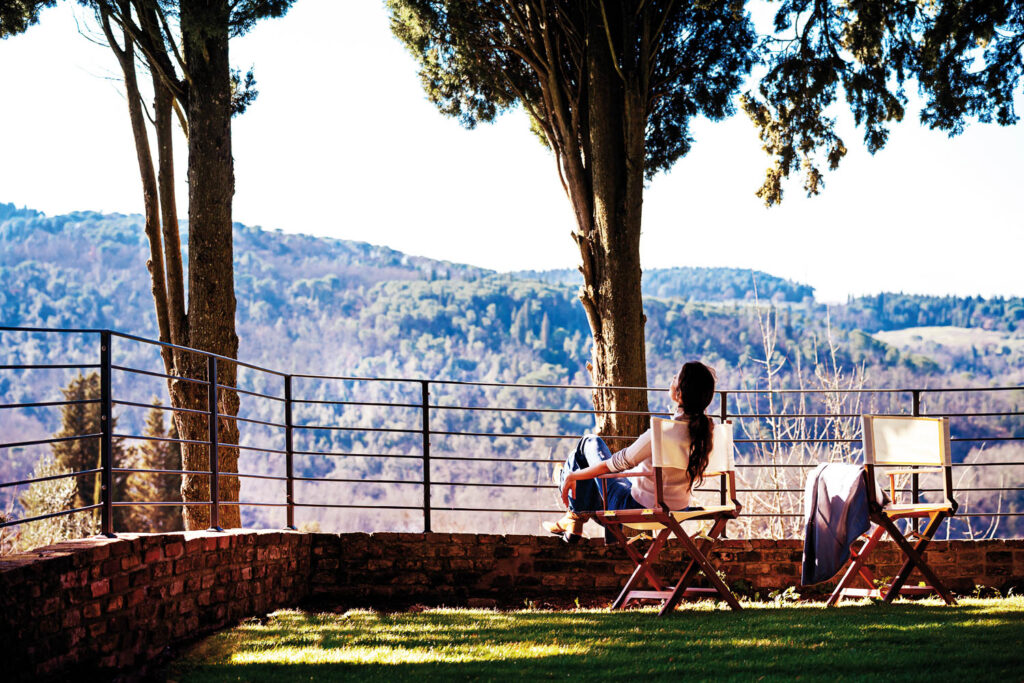
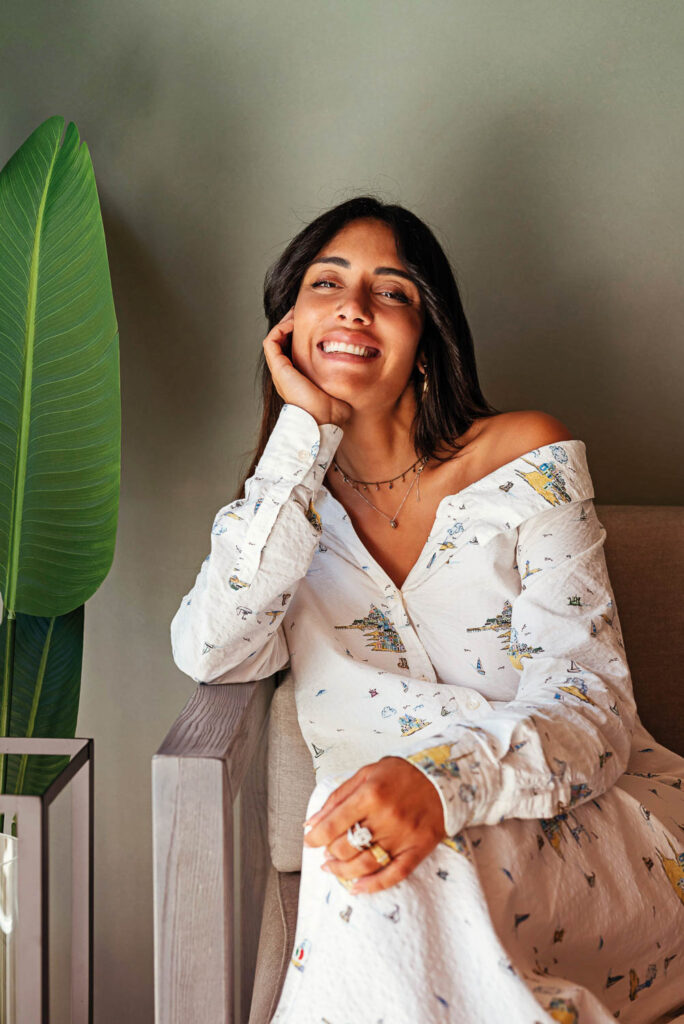
We meet Elettra Lazzerini in San Vincenzo, a picturesque coastal town in Tuscany that, until recently, remained largely off the international travel map. We are hosted in one of her beachfront apartments, where the view stretches across the Tyrrhenian Sea towards Elba and, on clear days, even Corsica. At 35, Elettra is pregnant with her third child and runs multiple hospitality projects across the region.
Ladies Drive: What was it like growing up in San Vincenzo? Elettra Lazzerini: I grew up watching my father create custom- made Italian furniture. I think his passion for craftsmanship and his eye for aesthetics are the reasons beauty has always fascinated me – and at times even obsessed me. His designs are beautiful, but always unique. That, to me, is real beauty. Like my father, I wanted to be strong and independent. My family passed on a deep sense of duty and ambition. I always knew I had to find something in life I could feel passionate about.
Looking at your projects, I think it is safe to say you found that passion in hospitality. When did you know you wanted to pursue this path?
My first job was as a teenager at Zanzibar, a restaurant in San Vincenzo that I still visit today. I served painters, musicians, directors, fishermen – people from completely different worlds. Working there was a profound lesson and one of the most beautiful experiences of my life. When I was 18, I stayed at a five-star hotel on the Amalfi Coast for the first time. I remember how deeply the level of service impressed me. In that moment, I knew this was my destiny. I did not yet know how, but I felt certain. Back in San Vincenzo, tourism was still very simple. I knew I had to find a way to stand out, so I began developing short-term rental apartments with personalised service. I wanted to offer guests the kind of care one would expect from a five-star hotel. It was a challenge – but also the best training ground I could have imagined.
Fast forward 13 years and you are now running around 40 apartments and a boutique hotel in San Vincenzo. What led you to expand your business into consultancy?
The idea came quite naturally. What started in San Vincenzo made me realise the potential of secondary tourism destinations, and I wanted to apply that to other regions too. There are more than 580,000 tourism facilities in Italy, many of them small, in- dependent structures. That is where the real potential lies. If we can elevate the level of hospitality, we can transform entire destinations and strengthen local economies. There are so many beautiful places to discover in Italy, but overtourism has become a real problem. That is why I want to give secondary destinations more visibility – because they are Italy’s true treasures.
Speaking of visibility, you have built an online following of more than 110,000 people. What kind of content do you create – and how do you stay true to yourself in a digital space so often driven by trends?
I create spontaneous, genuine content about my life and my work. I post about my projects, but I also share tips for other Airbnb hosts – from makeover ideas to the small details that make a guest’s experience feel special. I share what feels natural in the moment. In some periods I feel more creative than in others, but most importantly, I believe it is fine to express yourself without everything being perfect or overly curated. In fact, I think many of us are a little tired of that.
If you want to grow on social media, you need to post. How do you stay consistent without burning out?
I receive many requests to promote other brands as a content creator, but I turn most of them down. I am not interested in doing everything, and I think that would only make me more tired of social media. I use it very deliberately, focusing on my own niche. Beyond that, I try to use it as little as possible.
At what point did you realise your online presence was not just visibility, but a real driver of your business?
Today, more than 45 per cent of our bookings are direct, and the visibility I have built online plays a big role in that. We receive hundreds of messages from people saying they discovered San Vincenzo through my profile. Of course, that makes me very happy.
How do you decide what to share – and what not to share – online?
I mostly share my work, but also parts of my private life and my insecurities. I engage as well with topics around women and work, which is still quite a sensitive subject in Italy.
What do you mean by that?
Well, in some parts of Italy there is still a very conservative perspective that men should earn the bread and butter for the family, while women take care of the house and children. I think that can be the ultimate recipe for unhappiness. It is so important to have your own drive in life – something that is yours alone, something that makes you jump out of bed in the morning. I am fairly sure that is not cooking and cleaning the house. Although I, too, have days when I am exhausted and stressed from work, there is endless laundry, and I still need to take my children to football.
I noticed a trend on social media where my feed was filled with women romanticising the stay-at-home life. What is your take on that?
It is called the ‘trad wife’ trend. I find it concerning because young girls on social media are vulnerable to what they are exposed to. If social media encourages them simply to take care of their husbands, what does that mean for the next generation? I hope girls who follow me realise there is also a world full of excitement and dreams, where building something through love and passion is possible. And I hope younger women find joyinentrepreneurship.
You have built a loyal audience. How do you create trust online?
I take my work seriously, and I am very honest and direct. If someone asks me for advice, I always answer from the heart. I do not think about profit first. I focus on what is best for the person – whether that means recommending a villa or a consulting project. I want happy clients. It may sound utopian, but I genuinely try.
You have spoken about the pressure of doing many things at once – building a business, being visible online and raising a family. Has social media increased that pressure?
For a long time, my biggest mistake was never feeling enough. I think many women – both entrepreneurs and mothers – know that feeling. Never good enough. Never available enough. Never enough! Strangely, social media also helped me overcome that. Seeing other entrepreneurs admire my work and collaborate with me gave me confidence. Today, I finally feel enough.
Looking back, what advice would you give your younger self?
I would have ignored 90 per cent of the advice I received. Fortunately, I never listened to much of it anyway.