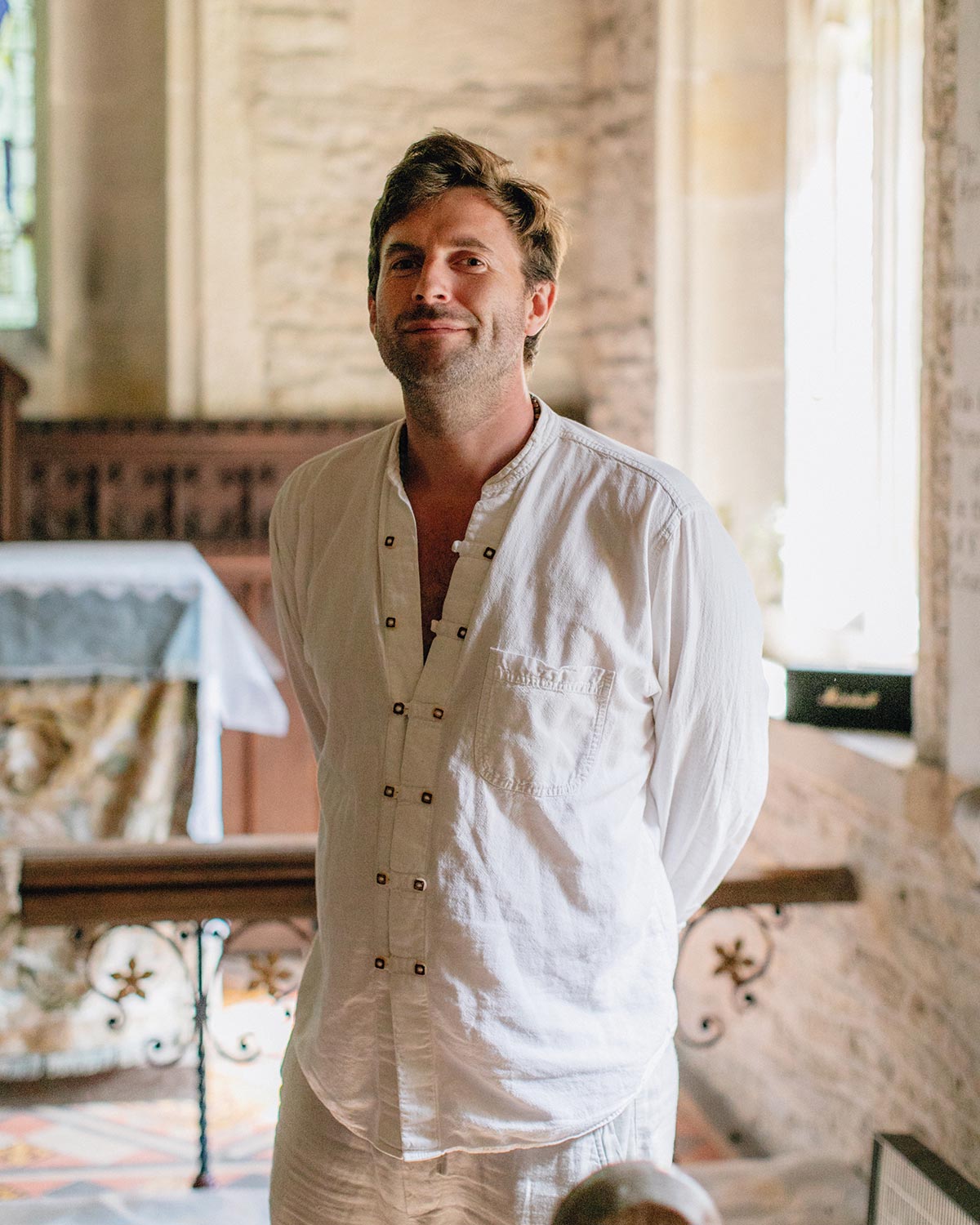


He completed a PhD at Cambridge on how singing forms community and co-authored Britain’s Pilgrim Places. Hayward has been interviewed about modern pilgrimage for Netflix’s Mysteries of the Faith and featured on BBC TV and Radio 4 discussing the resurgence and cultural meaning of pilgrimage.
It was last autumn when I began searching for a keynote speaker for our League of Leading Ladies Conference in April 2026. I reached out to Rupert Sheldrake, the renowned English biologist, author and researcher, best known for proposing the controversial theory of morphic resonance, which suggests that memory is inherent in nature. While he was not available, he immediately shared a website with me, pointing me to the work of researcher Guy Hayward, who completed his PhD at the University of Cambridge on how singing creates community.
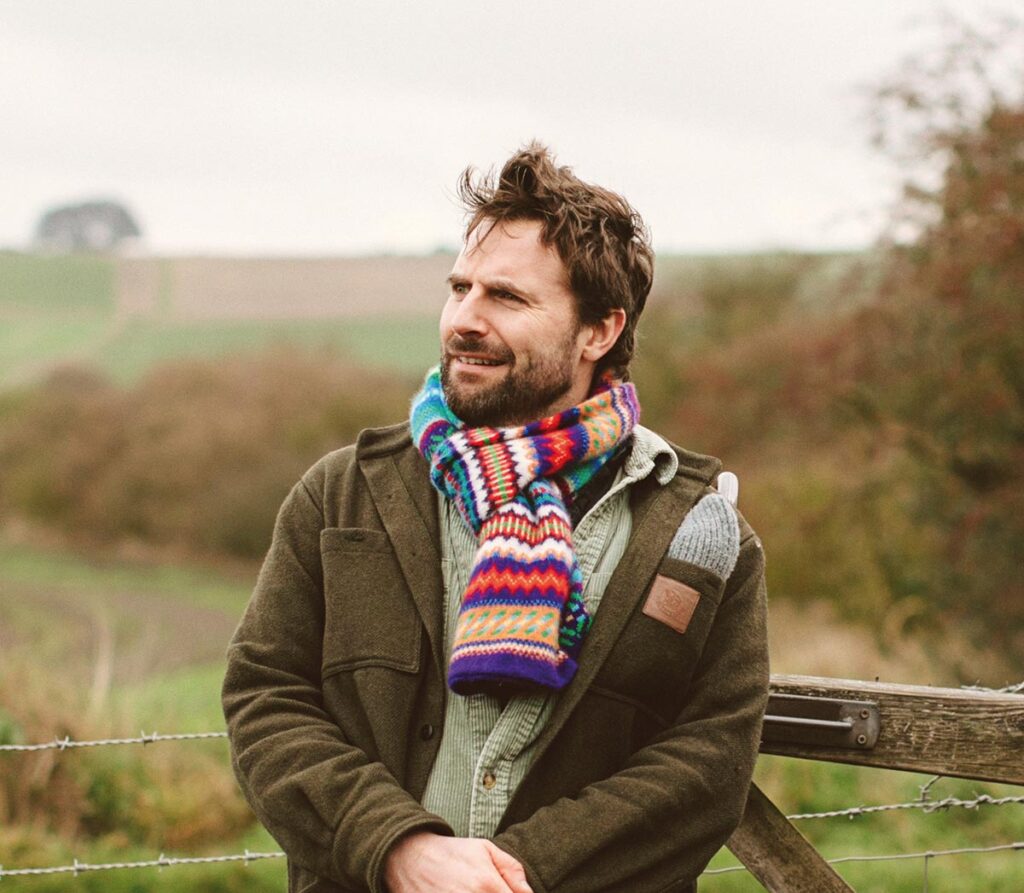
As soon as I learned about Guy’s doctoral research, I was both fascinated and deeply intrigued by this idea of singing as a force that brings people together.
Guy Hayward is also the Director of the British Pilgrimage Trust, which he co-founded in 2014 to promote the practice of “bring your own beliefs” pilgrimage across Britain. Since 2016, he has been leading guided pilgrimages, during which he invites participants into collective singing, drawing from nature-based, folk and sacred songs.
The English scientist and singer has been interviewed about modern pilgrimage for television and Netflix and has been featured in numerous British newspapers and magazines. And now, I have the great pleasure of sharing his journey with you.
It is an extraordinary conversation about reconnecting with nature and about how this reconnection can create a new kind of superpower we urgently need today: the ability to accept uncertainty and to embrace the unknown.
Ladies Drive: I have a favourite first question for interviews, and it goes like this: what’s the scent of your childhood? For me, it’s the scent of my grandmother’s lemon cake. It catapults me straight back to my childhood, to that light-hearted time when everything seemed fine and safe. What is yours?
Dr Guy Hayward: Probably the wildflower meadows outside my home on the hill. When I was about six years old, I used to run across them with our neighbour’s dog, Flossie. I just felt so free.
When you say “free”, do you still feel free in the same way – or to the same extent – as you did as a child?
In a sense, I feel even more free now. I have fewer fears and more independence. Pilgrimage plays a large part in reconnecting with that feeling.
Before we dive into the mindset of a pilgrim, let’s go back a bit. You’ve had a rather unconventional career. I imagine you didn’t dream of becoming a pilgrimage host as a child?
When I was very young, I wanted to be a table tennis player for some reason. Then I wanted to be a singer. From around the age of seven, I was a choirboy, sang solos, and music became a central part of my life. I drew a lot of identity from it. I carried that passion into my university years. At Cambridge, I was a choral scholar and planned to become an opera singer. But I didn’t, even after training in opera at a music college. Instead, I pursued a PhD in music psychology, focusing on how music – and especially group singing – forms community around the world. In a way, that PhD became a kind of stopgap. After completing it, I met a wandering minstrel, and we began walking together. That, in a nutshell, is how the idea of pilgrimage was born. My earlier need to become a singer in that traditional sense gradually fell away; it no longer felt essential. What I eventually realised, however, was that I could combine both worlds – nature and song. At Cambridge, I had always been drawn to music that connects us to nature – twentieth-century English composers deeply rooted in the landscape, as well as Schubert, who set Goethe’s nature poetry to music. When I rediscovered these songs, I understood that I could take them back into the landscape, rewild them. Folk songs, traditional songs – sung again in their original places, in nature.
Let’s talk about your PhD, because I love the topic. Can you share a bit more about it?
The first half is an anthropological study of how singing forms community through synchronisation in human cultures across the world. It explores how people become entrained with one another, a process that is scientifically complex. The focus is on community and on how singing brings people together into a sense of oneness. The thesis is titled Singing as One: Community and Synchrony.
The second half focuses on timing. Having a shared beat or pulse is the primary way people come into oneness with each other through music. I examined how humans get in time with one another and compared this with schools of fish and flocks of birds – particularly starlings – and how they move as one, even on a massive scale. For example, hundreds of millions of fish can form a school in under a second. Tens of thousands of starlings can evade a predator without a leader, the entire flock shifting direction instantly. In both cases, movement occurs through an impulse that travels across the whole group so rapidly that it cannot be explained by simple sensory transmission – like a domino effect. Instead, it points to a phenomenon often referred to as a “group mind” at work in nature. I studied research on 10,000 starlings over Rome, which revealed what is known as scale-free correlation: any single bird can influence the entire flock in an instant. It’s an extraordinary finding.
So it really is extraordinary. How on earth is that even possible?
I believe this idea of a group mind is what has guided much of my work ever since. In the second half of my PhD, I focused on Gregorian chant, which is not metrical, and examined how people come into time with one another. I explored different possibilities: whether synchrony emerges through eye contact, through breathing together, through subtle head movements, through hierarchies within the group, or through counting between musical phrases. But none of these explanations, taken on their own, were sufficient.
It almost sounds as if you’re describing a kind of telepathy.
Yes. I didn’t actually use the word telepathy in my PhD – because I needed to pass. There’s a rather funny story behind that. At the time, I spoke with Merlin Sheldrake and his father, Rupert Sheldrake, who is known for his work on telepathy. Our solution was to create a gaping hole in the explanation and leave it up to the reader to fill it with their own conclusions.
And you did exactly that?
Yes. During the examination at Cambridge, the examiners said: This sounds as if you’re suggesting telepathy. And I replied: Well, I haven’t said that.
And you passed.
Yes. I passed.
What happened next?
I was house-sitting for the Sheldrakes when I met two wandering minstrels from the English folk music scene. They had been travelling the land for ten years. I felt an immediate urge to walk with them, and one of them said: Yes, of course – let’s walk along the river and take this song back to where it came from. The song had been given to us by the folk singer Sam Lee. It was called The Hartlake Bridge Tragedy and told the story of 37 labourers, many of whom had died while building the bridge after falling into the river below. So we set off and walked along the river for a week – about 70 miles in total. As we walked, we learned the song and sang it to everyone we encountered along the way. When we finally reached the monument where the men were buried, a couple was already standing there. We asked what they were doing, and they said: ten years ago, we tried to find this place. Now we’ve finally found it – and we are here just for five minutes.
We asked about their connection to the tragedy. They replied: three of our ancestors died here.
Isn’t that extraordinary? What are the odds of meeting someone like that, in that moment, in that place?
They had never heard the song before. And suddenly, we were able to return the song not only to its place of origin, but to the bloodline itself. That was the whole idea – to take a song back to where it came from. This is the principle of rewilding songs. It was a deeply powerful moment. I felt a shiver run down my spine. From that point on, we kept saying to ourselves: something extraordinary has just happened to us. This was more than just a walk. In many ways, it felt like a pilgrimage.
Why did pilgrimage disappear in the first place? Why did people stop going on pilgrimages?
The idea of walking with a quest – with an intention or inner purpose – to sacred places was banned by King Henry VIII in 1538.
Why?
Because pilgrimage was considered too Catholic at a time when the Church of England was being established as a Protestant institution. Henry VIII needed to rebrand the Church, and one way of doing that was to sever the connection to the material aspects of spirituality: the belief that bones, places, the land itself, and the physical world could hold spiritual meaning. You could argue that many of the challenges we face in the West today are connected to this rupture, to a deep disconnection from the earth that emerged during the Reformation. A new philosophy took hold, one that privileged the written word and intellectual belief above the body, place, land and physical experience.
So for 500 years, there were no pilgrimages in Britain?
Yes. Because of the ban, Britain effectively had a clean slate. For around 500 years, pilgrimage as a practice largely disappeared. When we began thinking about reintroducing it, we realised something powerful: we could create a new ’free’ tradition. Crucially, we chose not to link it to the Church. Instead, everyone is invited to bring their own beliefs, faiths or worldviews. That, I believe, marked a significant shift in the global landscape of pilgrimage. Everyone is a pilgrim, really, because we are all on a journey in our own way. Pilgrimage, then, becomes about enchanting the journey itself, enchanting the act of walking.
And reconnecting with the magic of nature?
Exactly. If you look at cultural phenomena like Harry Potter or The Lord of the Rings – these vast, multi-billion-dollar franchises – you can see how deeply they tap into something fundamental. I believe that something is the re-enchantment of nature, the re-enchantment of the world, something we have been missing for a very long time. Pilgrimage can help people reconnect with that sense of magic. But it can also support people through very tangible human experiences: losing a job, losing a partner, bereavement, burnout, depression, retirement – those moments of transition when life shifts. Walking through these moments allows people to gain an entirely new perspective.
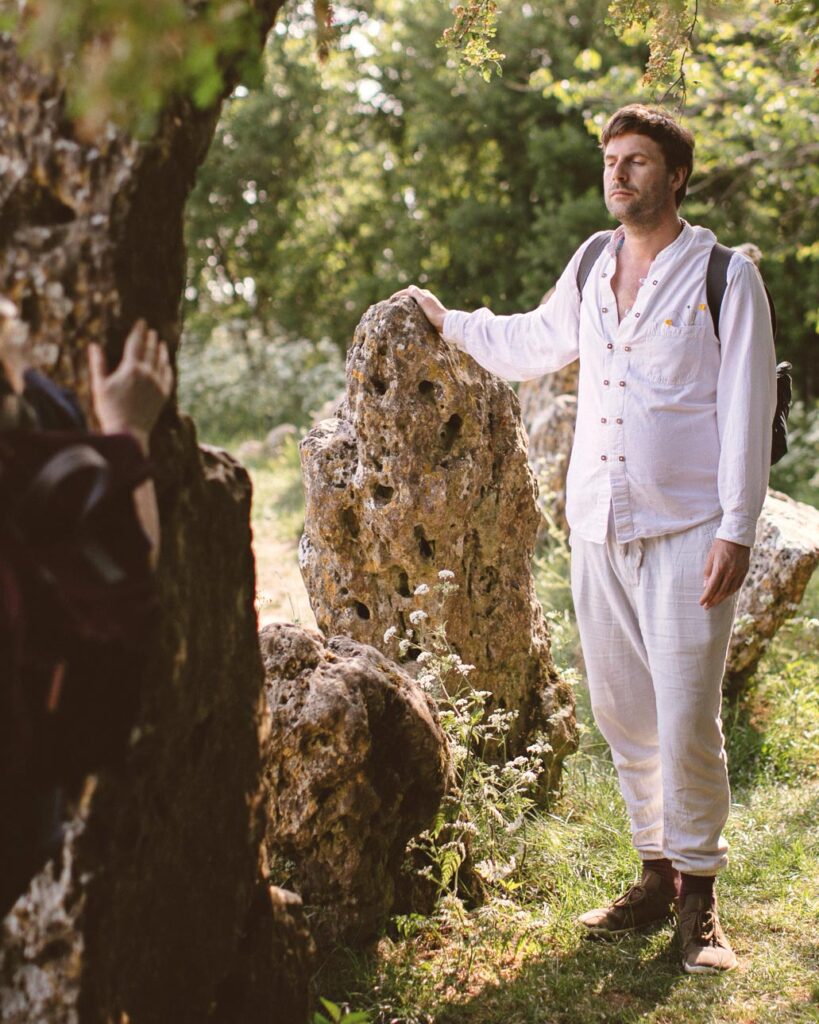
So you walk – and your issues unfold along the way?
There’s a Latin phrase often used: solvitur ambulando – it means that complex problems are solved by walking. One reason I’m so drawn to pilgrimage is that many spiritual practices and therapeutic approaches are effective but often require complex entry points. You need prior knowledge, specialised training, courses or experts – someone to teach you, or to do something to you. Pilgrimage is different. It is scalable. Most people can walk – and even for those who cannot, there are alternatives. At its core, it is simple: putting one foot in front of the other, and allowing the journey to do the rest. That simplicity is precisely what makes pilgrimage such a powerful and accessible spiritual practice for all types of person, and perhaps especially for leaders, as it creates one of the few practices in which you don’t have to perform competence, as the whole point is that you’re allowed to be in process. It can have a profound impact on people’s lives, sometimes even transforming them entirely, simply through the act of walking. For these reasons, we’re seeing pilgrimage gaining the interest of charities, universities, mental health groups, farmers, artists and even corporate leaders.
You’re doing charity work – but to be honest, it’s also a very strong business model.
If you look at a place like Santiago, for example, you see how pilgrimage can become a brand. It has a recognisable logo, a clear identity. That brand can then be leveraged to accredit and endorse hotels, restaurants and services along the route. In that sense, pilgrimage becomes a boost for tourism – tourism with purpose. All the mechanisms through which tourism generates income also apply to pilgrimage. In Santiago, the rural economy has grown by around 900 per cent over the past 20 years. Another important factor is that pilgrims tend to spend more locally. Because they are walking, they rely on what is immediately around them – food, accommodation, small services – which means their money flows directly back into the local economy. That said, we don’t exist to make money for its own sake. We are a charity. In many ways, we give our work away almost for free, precisely so that as many people as possible can take part. But if you look at the current mental health crisis, one has to ask what lies behind it. One reason may well be our deep disconnection from the natural world. A disconnection from the body. Perhaps what we need are these old, timeless practices like pilgrimage. We need to step away from our phones, slow down for a while, address mental health more honestly, and reconnect – not only with nature, but also with our ancestors.
How do you make sure that Gen Z participants don’t walk the entire pilgrimage with headphones on?
If they really insist on wearing headphones, then perhaps we offer them stories – stories of pilgrims, stories that enchant the landscape as they walk, so their minds stay engaged. But inevitably, if you’re on a pilgrimage, something shifts. At some point, you take the headphones out and suddenly start listening to the birds. Pilgrimage has a way of peeling back layers. The longer you walk, the more falls away. Gradually, you begin to understand what truly matters.
Being a pilgrim also means facing uncertainty and allowing yourself to be vulnerable, doesn’t it?
Vulnerability is almost sanctioned in pilgrimage. People instinctively understand that this is what the journey is about. In business, by contrast, you are usually working towards clearly defined goals. You plan. You try to control outcomes. You are accountable to investors, shareholders and stakeholders – people who expect predictability. What pilgrimage teaches you instead is trust. Trust that things will work out. You begin to tap into a kind of higher intelligence. Synchronicities start to appear: you meet the right person at the right time, conversations happen when you need them most. There is a sense of relinquishing control to the journey and seeing what unfolds.
Many business leaders today say that uncertainty is what stresses them most.
And uncertainty makes us vulnerable, because we don’t know what will happen next. On pilgrimage, you have no choice but to let go. You allow the complexity of nature to take over. You learn to be comfortable in a space of not knowing.
Pilgrimage gives you time to inhabit that state. And when you return to business life, you carry something back with you: a deeper sense of trust. Trust that even if you allow yourself to be vulnerable, even if you can be wounded, you ultimately won’t be – if you let the magic of life do its work.
Because we take a leap of faith?
Yes. If you look at the first card in the tarot deck, it is The Fool. It shows a pilgrim stepping off the edge of a cliff, a bundle slung over his shoulder, a white rose in his hand, a dog by his side. And he looks joyful as he walks into the unknown – walking off the edge of the cliff with a smile on his face. That is the primary archetype of the pilgrim. When people set off on pilgrimage, they don’t know what will happen. I think that is exactly the state many business leaders find themselves in right now: all the rulebooks are being torn up at once, across economics, politics, science and culture – every dimension of life. The way forward is not to try to control that discomfort, but to learn how to sit with it. You could argue that this is the essence of the Divine Feminine: the ability to sit with the chaos of life without needing to control everything, while still trusting that there is an underlying order, a deeper alignment.
What will you share with us when you visit Interlaken for the League of Leading Ladies Conference in April?
I will speak about pilgrimage as a way of being and try to demystify it. My aim is to help people understand the core principles of pilgrimage: setting out without expectations, accepting whatever the journey offers, rather than wanting it to unfold in a particular way.
You spoke about the “right message”. What is the message business owners and CEOs most need to hear right now?
I think the message is to return to the beginning – to become a beginner again. In Buddhism, this is known as beginner’s mind, and it is closely aligned with the way a pilgrim walks. We are in a moment where none of us truly knows what the next steps will be. We may have a sense of direction, but not a clear map. That direction will likely involve a more inclusive spirituality, a deeper connection to ecology and the earth, and a renewed sense of oneness with nature and each other.
Of course, whoever you are, you’re walking the same path, carrying your own bag, dealing with blisters and weather like everyone else. There’s no stage, no title, no “expert” position to maintain. When there’s no hierarchy, it’s easier to be honest with each other. Business leaders are trained to stay in the head, but walking for hours softens cognitive defences, regulates the nervous system, and allows emotions and doubts to surface without being forced. Vulnerability is a by-product of all this, and teams need vulnerable leaders who can stay present in times of uncertainty.
We need to go back to basics and see whether we can rebuild from the ground up. We have made extraordinary advances in medicine, finance and technology – all of them valuable. But if we can now integrate these achievements with older ways of being, that may be our path back to health and harmony. Perhaps it also helps to recognise that we are apprentices for life – and to life itself. There is also the question of slowing down and listening. The idea is almost overused, but there are forms of connection – in the mind and in the body – that only emerge when we slow down. Walking, in particular, creates a more creative mindset. Many of history’s great thinkers – Einstein, Darwin, Beethoven – were walkers. They walked to listen, think, to discover, to create. That is an important reminder for today’s leaders.
Maybe we should stop holding seated meetings and start walking together in nature. That could be a good place to begin. Even in cities, people are starting to walk to work, sometimes for an hour or more. In London, this is becoming a real trend. They don’t experience it as a commute, but as part of their day: meeting people, stopping for coffee, listening to birds, noticing the seasons change, moving their bodies. It reconnects them – and it changes how they think and feel.
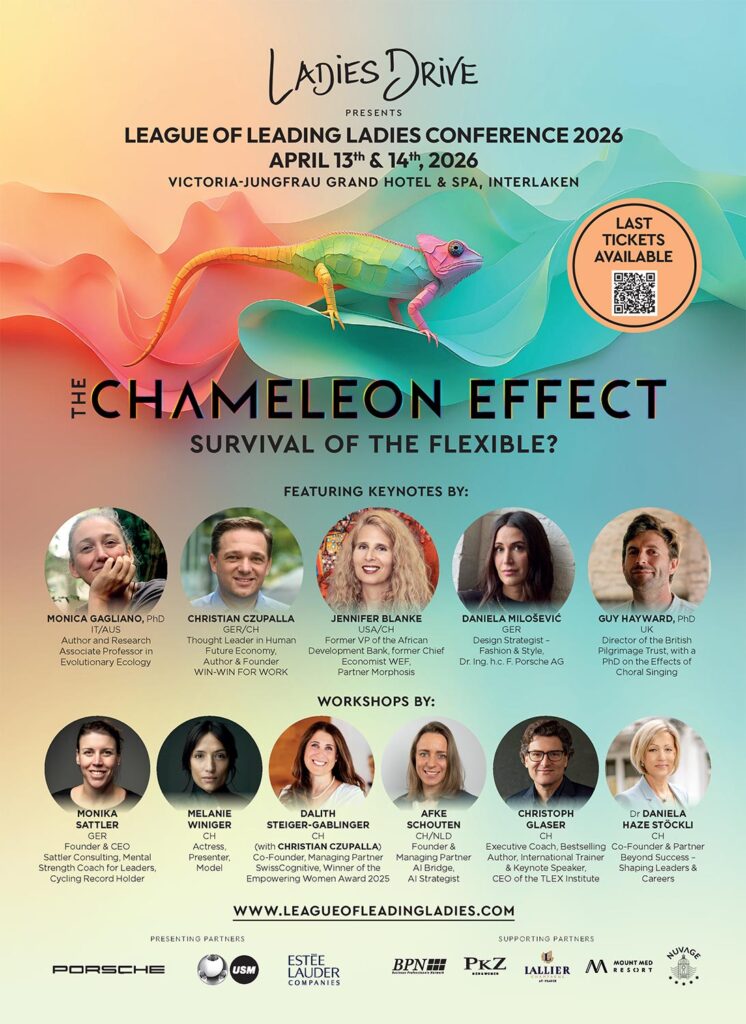
Meet Guy Hayward live on stage at the League of Leading Ladies Conference by Ladies Drive (13–14 April 2026) – and step into a conversation about walking, wonder and the courage to trust the unknown.